Note: All information contained in this post is based on my best understanding and perception of what transpired. I have confirmed with the founders that none of the information contained herein is deemed confidential and is therefore fair game for me to share in this post.
In April 2008, I was introduced to Ugmode, Inc. (thanks to my advisor Terry Winograd). The founders of the company — Arlo Faria and AJ Shankar — were PhD students in Computer Science at UC Berkeley. Arlo and AJ had built a stunning new way of doing product discovery for soft goods. I define soft goods as the category of goods where you’re shopping based on the appearance of the goods (for example, shoes, clothing, sunglasses, watches, jewelery and furniture) rather than the specifications (most consumer electronics fall into this category). So far, almost every shopping website shows products either in an endless list of “Next Page” links (hint hint Amazon — you have so much room for improvement!), or by using keyword search, which doesn’t really cut it. Arlo and AJ had devised a way to use shape and color as the two axes that helped to discover soft goods.
Their site — Modista.com — started out with shoes. When you arrived on the site you saw a diverse set of shoes. You picked the one that was closest to what you wanted (for example beach flip flops vs. dress shoes) and then Modista used that shoe as the seed for showing you a new collection of shoes, sorted by color on one axes and shape on the other. The site automatically adjusted to any display size (anywhere from the iPhone to a 26″ widescreen display) to show you the maximum number of shoes possible. Each time you clicked on which one you liked and the site refined its selection of shoes based on your input.

It created a fabulous experience for browsing soft good inventory based on what you’re visually looking for. In the user’s mind he or she would be thinking, I want a red shoe, with high heels, but you don’t need to translate that into keywords, you just click on what you like till you get closer and closer to what you like. Progressive refinement at its best.
On the back-end Modista was doing some heavy duty computer vision and image similarity comparisons to produce these results in near real-time. As a two-person team Arlo and AJ built out the whole site and the back-end technology — and built it to scale — at one point they did a A/B test on Zappos and were easily able to handle all the traffic coming to the Zappos test site while being able to show results from the enormous Zappos inventory.
Modista was the perfect fit for K9. It was a team of two sharp Computer Science PhDs, they had core new technology in the form of the algorithms they ran in the back-end, and also core new technology when it came to the display of information. Their business model was to provide retailers with a new interface for shopping for soft goods — something that hasn’t changed a whole lot since Web 1.0. Modista had built Shopping 2.0.
I closely watched the company’s progress over several months and was in awe of the quality of the founders and their execution. On multiple occasions I expressed my interest to invest in the company. The first time I asked them what they needed, they said they just need to crank out code. And crank it out they did. On future occasions, whenever I expressed an interest to invest, the founders came back and told me that they had an acquisition offer on the table! This happened not just once, but multiple times. Every big company in the online retail space wanted to buy them at some point along the way.
One occurrence of this was in Q1/Q2 2009. Modista was in talks for being acquired by a major player in the retail space – Zappos.com. While Zappos was doing diligence on Modista, the issue was brought up that one of other companies in this space — Like.com, founded by Munjal Shah — had filed for some IP in this area. Modista had been forewarned that Like.com had a “history of being litigious”. While I cannot be certain of what the actual reasons were, my speculation is that Zappos didn’t want to rock the boat by going through with the Modista acquisition, because concurrently with their discussions to acquire Modista, they themselves were engaged in discussions to be bought by the 800-pound gorilla in the space — Amazon.com.
In August/September 2009, the founders and I agreed to work together to raise a round of financing for the company. I helped introduce the company to various angels and lead the effort to form a syndicate for their fund-raising round. We pulled together about $600K of commitments and interest, for a $500K-target financing round.
As I mentioned, Modista’s closest big competitor in the space was Like.com. Like.com was already aware of Modista, and, (I believe) was also aware of the fact that Arlo and AJ were out trying to raise money. The day before we were supposed to sign the term sheet for the investment, Like.com sued Ugmode (the parent company of Modista.com) for patent infringement. Apparently, Like.com had a patent (‘610 patent) issued about two months before in the broad area of using computer vision for product search.
In my opinion, this is a patent that should never have issued in the first place since there is a lot of prior art in the space, including a lot of academic literature that should have (again, in my personal opinion) invalidated the Like.com patent to begin with.
To Arlo and AJ’s credit, as soon as they got served, they called to let me know what was going on. The lawsuit completely killed the financing prospects for Ugmode. The estimate for resolving a patent infringement dispute was about $1M in legal costs and the process could potentially take at least 2 years. Regardless of how much I liked the founders of the company, I could not in good conscience invest my LPs’ money in a company where a significant amount of the proceeds of the financing, if not all, would go straight to lawyers. The reaction from all the other committed investors was also appropriate and unanimous: “We love these guys, and it sucks to see this happen to them, but we can’t sign up for a lawsuit.”
At this stage, the team had had no prior financing. They had a small amount of cash in the bank from having won two business plan competitions that they used to finance the company to date. To put in bluntly, Modista didn’t even have the cash to be able to hire a patent litigator to defend them in this frivolous (in my opinion) lawsuit brought about by a company to simply try and reinforce its patent position against bigger players.
Modista had only had modest revenue to date (~5K) and had by no means gotten to the point where it was having an impact on the revenues of Like.com. However, it was clear to me, and probably to Like.com as well, that even as a two-person team Arlo and AJ were technically far superior to anything Like.com could ever produce and hence were in the long term probably a threat to Like.com. (Note: Like.com never asked for any damages in the lawsuit and only wanted an injunction against Modista)
Arlo and AJ are way too nice to go around slinging mud at anybody. And it’s been with their guidance that I have refrained from telling this story publicly before. They prepared a fairly long dossier of information which showed that the Like.com patent should have never been issued by the PTO and also dissected the patent sufficiently to show that even if the patent was upheld, they weren’t doing exactly what was in the patent anyway. However, even though as Computer Scientists they could examine and explain this to any other person who was a Computer Scientist, explaining it to a judge and to a jury would probably be a different ballgame altogether. That falls into the realm of hiring and paying for high priced litigators who can twist and turn words for an audience that isn’t an expert in the subject.
Apparently in a meeting with Like.com’s founder and CEO, Munjal Shah, they were essentially told that they should give up their own startup, and just come work for Like.com. I don’t know about you, but as an entrepreneur if someone threatened me that way I’d tell them exactly where to put their words and their smart-ass idea.
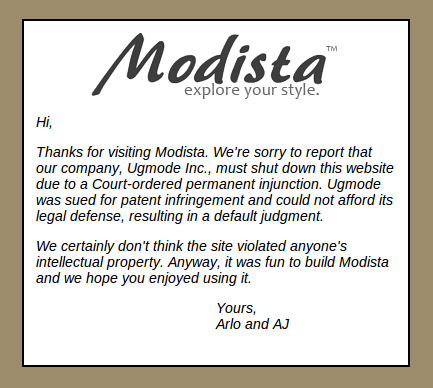
Apparently a corporation can only be represented by an attorney in a litigation and cannot be represented by the founders or officers, even if the company cannot afford counsel. Long story short, the lawsuit torpedoed Modista’s financing. And since they didn’t have the money to hire lawyers to defend themselves, they had to accept a default judgment against the company, which forced them to shutdown Modista.com.

A few months later, when I heard that Google was acquiring Like.com, I was only more disappointed. Google so far has played nice with startups and has had a positive impact on the startup eco-system (especially for exits, less so for hiring!) Google now owns the patent that caused Modista.com to be shut down. I sincerely hope the folks at Google read this post, so that they know what they bought.
The Valley thrives on innovation and creativity. Arlo and AJ demonstrated their innovation and their creativity in what they created with Modista. It is really sad to see two sharp young entrepreneurs spend more of their time learning about the intricacies of the legal process, rather than getting to spend time on building their product and their company. It is even more sad to see companies such as Like.com that prey on small young startup founders before they’ve even gotten out of the gate.
I’m all for competition and for a fair fight. Fight on the basis of a better product, a better user experience, fight on pricing, fight on things that show that you are better. But using your big VC dollars to put fledging startups out of business, that’s just in bad taste. To that effect, it’s probably good to also mention that Like.com was backed by First Round Capital, BlueRun Ventures, Bay Partners, Leapfrog Ventures, Menlo Ventures and Crosslink Capital to the tune of $47.3M, according to Crunchbase.
The purpose of this post isn’t to debate the pros and cons of software patents. If you’re interested in that discussion, my advisor and mentor, Brad Feld has written extensively about software patents on his blog. My friend Daniel Tunkelang has also authored several blog posts on this topic on his blog, some of which are inspired by (and also mention) Modista. To summarize that discussion, the system is broken at many levels. Starting from the overburdened PTO that issues these software patents all the way to the complexity of IP litigation which makes it prohibitively expensive to defend against unwarranted lawsuits.
Like.com has been assimilated by the big G, so we can certainly hope that they won’t be out to get other fledgling startups (and yes, I’ve seen many more startups using computer vision based techniques — something Like.com wanted the world to believe they had a monopoly on). However, the IP climate remains unchanged, and it’s likely that other villains will continue to exploit similar situations.
The Valley is a fascinating place — you hear stories about it every day. But not all the stories in the Valley get told. I didn’t want the story of Modista going untold and so I’m taking it upon myself to share their story — from my perspective.
We all like a story that has a good ending. This one didn’t end well. But, having worked closely with Arlo and AJ through the thick and thin of this journey I have nothing but the utmost regard for them as entrepreneurs. I told them then that “Whatever you do next, I’m ready to back you anytime.” They’ve both since moved on. Arlo is back at Berkeley wrapping up his PhD, and AJ is now working on a new startup, which I’m proud to be already be an investor in.
So here’s a toast to Modista.com — the site that built the best new shopping technology I’d seen in a while, but didn’t survive.
This post originally appeared at K9 Ventures.
For the latest tech news, visit SAI: Silicon Alley Insider. Follow us on Twitter and Facebook.
Join the conversation about this story »
See Also:


The Story Of The Greatest Shopping Technology That Never Was
Backlink: http://feedproxy.google.com/~r/typepad/alleyinsider/silicon_alley_insider/~3/C2ei3S_eiGw/the-story-of-the-greatest-shopping-technology-that-never-was-2011-4


 What started as a routine dispute at the nation’s No. 1 prep school has gone nuclear on social media. Nick Summers on what’s really behind the outlandish accusations.


